
Highlights-Return to London (Soho)
Returning the rental car required laps around Heathrow (almost) because I kept missing the turns (there’s a shocker). Missed turn or not, I kept the left, which was the important thing. I returned the car with scratches noted. How did those get there? (I was covered). The Heathrow Central Bus Station required an underground walk (a long walk) from T2 (supplemented with travelators, cool name for moving sidewalks). The apartment location was excellent and, while small, it was large enough for my needs. Key feature: wall-mounted electric heaters, which provided splendid heat (first thing I look for). Trafalgar Square was less than a kilometer away (they don't 'do' metric distances in England, but I do). This permitted a speed tour of the National Gallery (before it closed) and an opportunity for videos in the square (before dark).
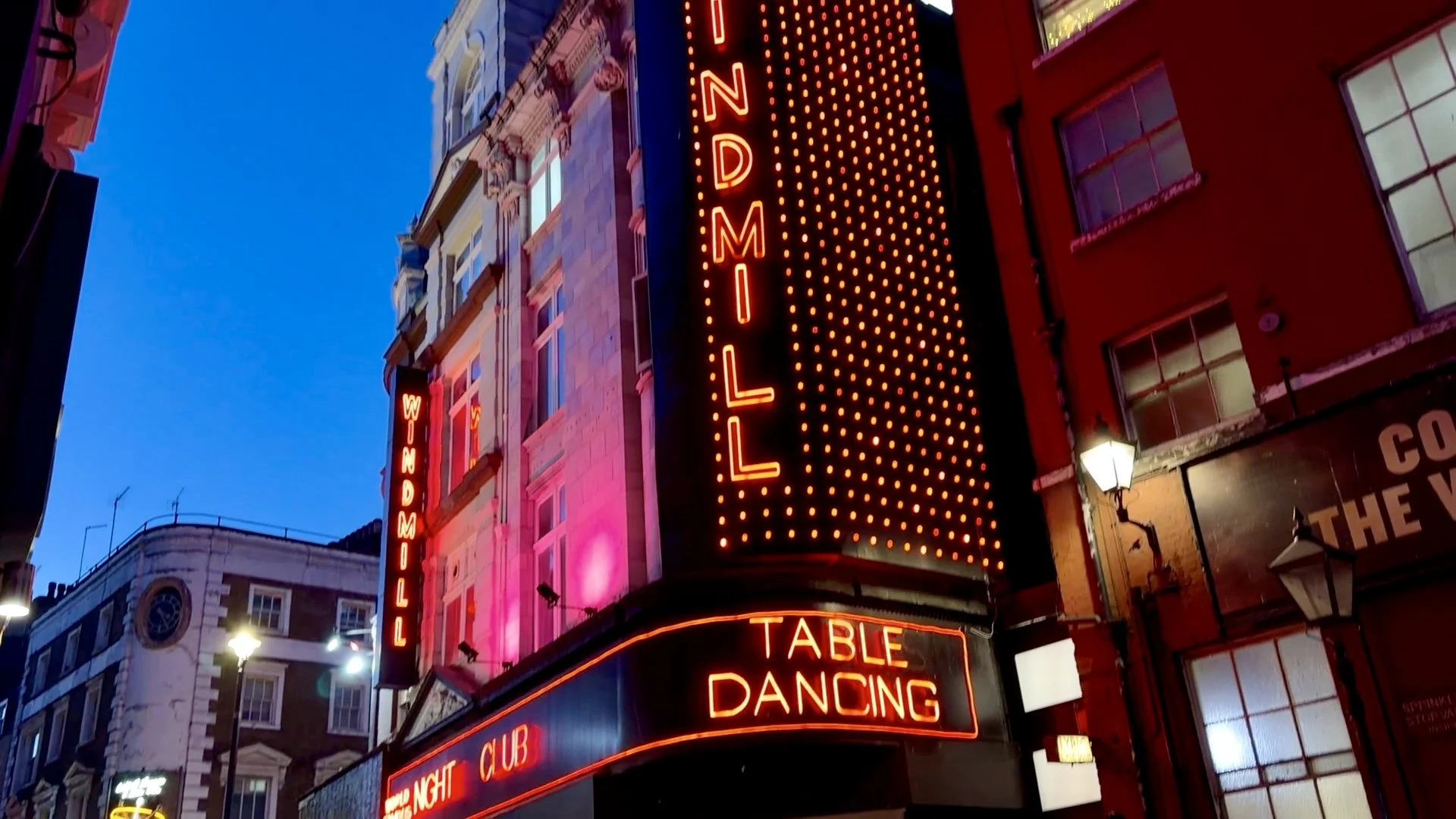
Ambiguous?
I don’t think the tables are doing the dancing (just a guess since I didn’t go in)
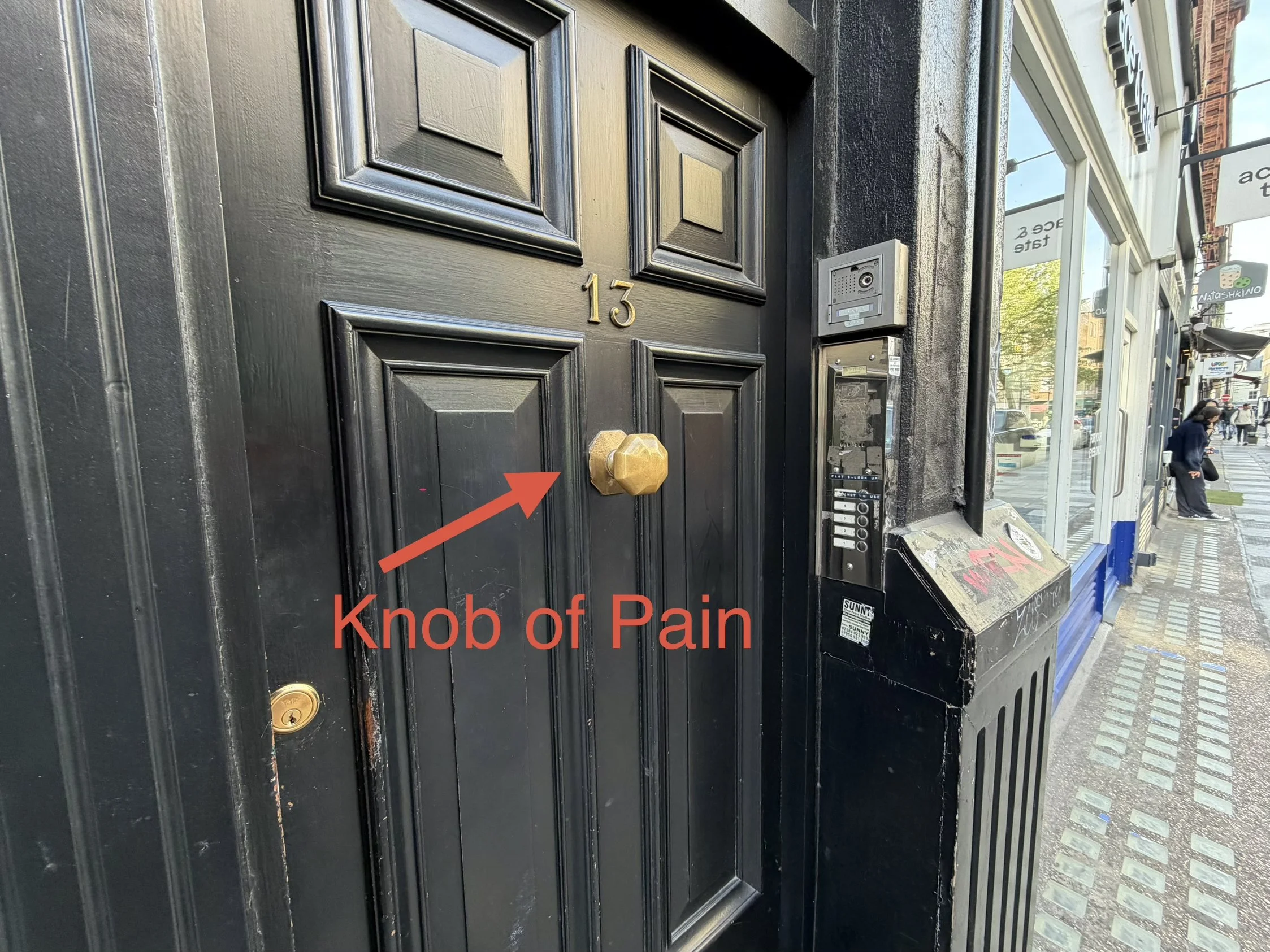
Slow Learning
That knob hit me on the shoulder at least FIVE times before I learned to be careful shutting the door.
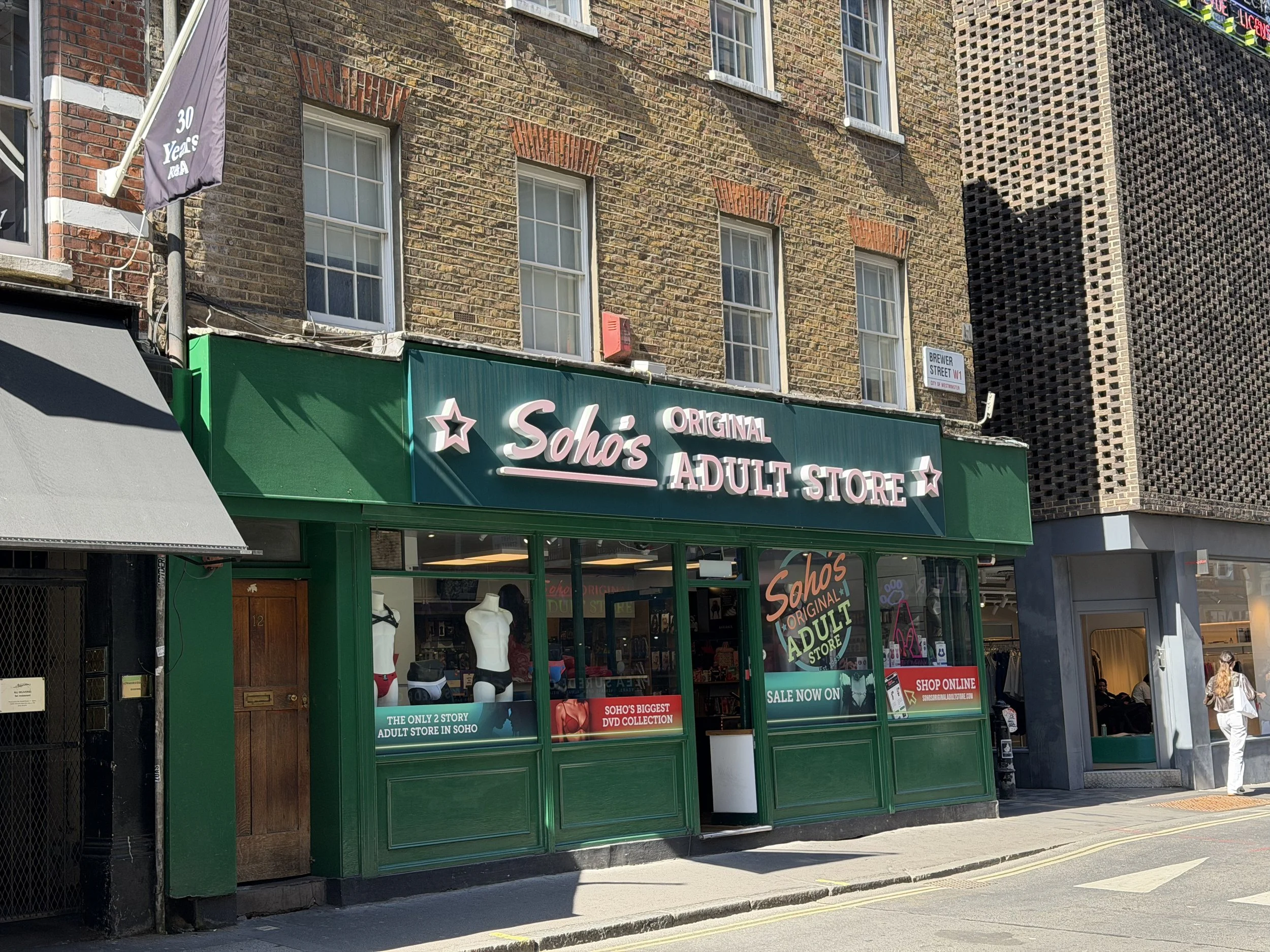
Great Landmark
Just for bearings, not browsing

Trafalgar Square
Soaking up the London vibe
Notable Items
Breakfast was included with my reservation at the Port Hotel, so I had the Full English. The rationale, coming from the traveler who normally doesn’t eat large breakfasts, was that I wouldn’t be ordering a fry-up (alt name) again. It was great. The serving had the best mushroom so far. I think it was a grilled portobello top (none of those thin slices of wimpy mushrooms nonsense!).
The drive to Heathrow from Eastbourne was 90 minutes. This gave me some time to think about the driving experience over the past week:
* The rental car’s dash display periodically flashed a yellow coffee cup icon with wavy lines (heat) above and “caution”. I had no idea what this meant. Don’t spill your coffee in your lap? It would be nice to get a card explaining the symbology and warnings when you rent a car, but we don’t live in that world.
* A feature I’ve seen in rental cars in Europe is beeping to warn when you exceed the speed limit. There is technology, not without accuracy problems, for communicating such limits to the system. During my first several days of driving, I considered this annoying and wondered if the alert could be deactivated. By the end of my week of driving, I considered it useful because I could focus on the road and traffic without having to pay as much attention to the speedometer. The European countries where I have driven have “national” and “standard urban area” limits. Drivers are expected to know and heed them without the pervasive limit posting seen in the U.S.
* I used my “keep left” note during my week of driving in England, but it frequently fell from the vent. I decided to mimic something I’d seen years earlier in Ireland: a note on the dash at the edge of the windshield-dash interface that reflected onto the lower edge of the window. It wasn’t a note like I used, but a sticker on the dash. That’s impractical in a rental car, of course. Solution: a new version of my note with upside-down letters. The reflection read correctly in the windshield.
* While roundabouts are still local curiosities in the U.S., they are ubiquitous in Europe. I’ve encountered them many times and understand the basic theory: enter one direction, circle until the desired exit, leave. I have difficulty with two practical aspects. First, reading the signs fast enough just before entry to know which exit to take. Once in the roundabout, destinations usually aren’t marked on the exit signs. Without a map app or navigator, this is tricky. I learned this driving alone from Plasencia, Spain to Cáceres when my mobile had signal problems.
* Second, which lane should you be in as you circle? Sometimes, the farthest outside lane (left or right, depending on the country) is marked as “first exit only” with an arrow. That’s clear: don't be in that lane if you need a later exit. If I get in the lane closest to the center of the circle, there is often a car on the side that could block my exit. Every time I enter a roundabout with other vehicles next to mine, I get a “Look kids, there’s Big Ben, Parliament” flashback. It’s automatic. I watch the cars on my side and for my exit and hope for the best.
* On most divided highways in Europe, it is rare to see services clustered near the highway for quick exit and return. This is standard in the U.S. Except for the service areas between the opposing directions of traffic in England, drivers get no help. In the U.S. outside major urban areas, there are signs telling you which services are in which direction and how far you have to drive when you exit. I only notice how useful this is when it’s absent.
* Most of the signage and icons on English roads are clear, but some require some translation:
* Single track road (one lane?)
* Temporary signals for road work, usually in small towns: stop when lights are showing (flashing?)
* Lane closed for technology testing (what are they testing, lasers?)
* Free towing-Remain in car and await rescue (who’s watching for drivers needing towing and how quickly will you be rescued?)
I think Soho is one of the most interesting places to stay in London. It’s gritty, flashy, cool, trendy, and seedy all at the same time. There are leather underwear and whip shops next to gourmet groceries. I stayed in Soho for nine days in 2019, which is why I returned this trip. On my first night in London on 10 April, I walked to and around Soho looking for the apartment where I stayed, but couldn’t find it. After arriving at the new apartment this time, the old one was easy to find. I recognized the alley that led to it because of a leather underwear shop (I passed it frequently in 2019). It was just a landmark, not a shopping interest. Leather chafes.
For my first supper (“evening meal” at the Naval Academy) in my new surroundings, I chose YeYe Dumpling and Noodles. There are noodle shops every 20 meters in Soho. This place’s “thing,” clearly indicated in Yelp reviews, was a 2lb (0.91 kg)-size beef chuck roast, bone in, placed in the bowl of noodle soup. Try eating that with chopsticks. I didn’t even try, but I had to ask for utensils, so maybe I was supposed to. After wondering, “How am I going to eat that?,” the second thing that occurred to me was, “There goes my shirt” (noodle broth splatter is a problem for me).
Oriental people I have observed eating noodles manage this well. They pick up the bowl to keep the splashing surface above their shirts. Picking up the bowl isn’t practical when the broth is hot enough to melt lead like this was. Like slurping soup, this is perfectly acceptable in their culture. Aside: You’d slurp soup too if you ate it with a tiny backhoe shovel like they do. You can’t even get your lips around it!
My approach to minimize noodle broth flying onto my shirt is a slight modification to the oriental method. Instead of lifting a bowl that is too hot, I put my head so low over the bowl that my lips are nearly touching the contents before I shovel part of a glob of drippy noodles into my mouth. I’ve done this so many times and saved so many shirts that I don’t care what observers might think, if they even notice me.
The face over the bowl thing was working until the very end. I thought I was home free after managing to eat less than half of what I was served. Of course, this made me complacent and that leads to carelessness. I was putting the bowl contents into tiny plastic boxes for take away. Tiny boxes for a piece of beef the size of my forearm! What’s up with that? I flubbed the transfer of beef to box. I dropped it into the noodles and broth, splashing my shirt. Sigh.
The construction and location (first floor) of the apartment permitted street sounds (muffled) to penetrate. There is a lot of people traffic on the sidewalks of Soho. I didn’t find it distracting. Unlike vehicles and bands marching in the street, voices generally blur into white noise if there are enough of them. The volume became much lower after 11pm and the voices were unnoticeable after midnight.