
Highlights-Portsmouth Day 1
I got up way earlier than someone on vacation should in order to arrive at the Tank Museum when it opened (outside Bovington, over an hour west of Portsmouth). They have the world’s only functioning Tiger tank (this was “Tiger Day”-they only do two a year). They have many other operational tanks and put on a mock battle show. This is amazing because it was hard enough to keep them running when spare parts were available 80 plus years ago. They stage mock battles in an enormous park called the Kuwait Arena (complete with narration). It looked more like Tunisia than Kuwait (too much green stuff for Kuwait). While driving there, I observed that raspberry cream filled donuts at Starbucks in England are just as icky sweet and processed as in the USA. Back in my AirBnB “room above the garage,” I battled with the room radiator remote control to produce more heat than I could generate from rubbing my hands together. It wasn’t easy, and it produced vibrations loud enough that the host noticed. “Have you heard a banging sound?” “Yes, I have.” “Must be air in the pipes, I’ll bang on them tomorrow” — very British.
That way to the Tank Museum
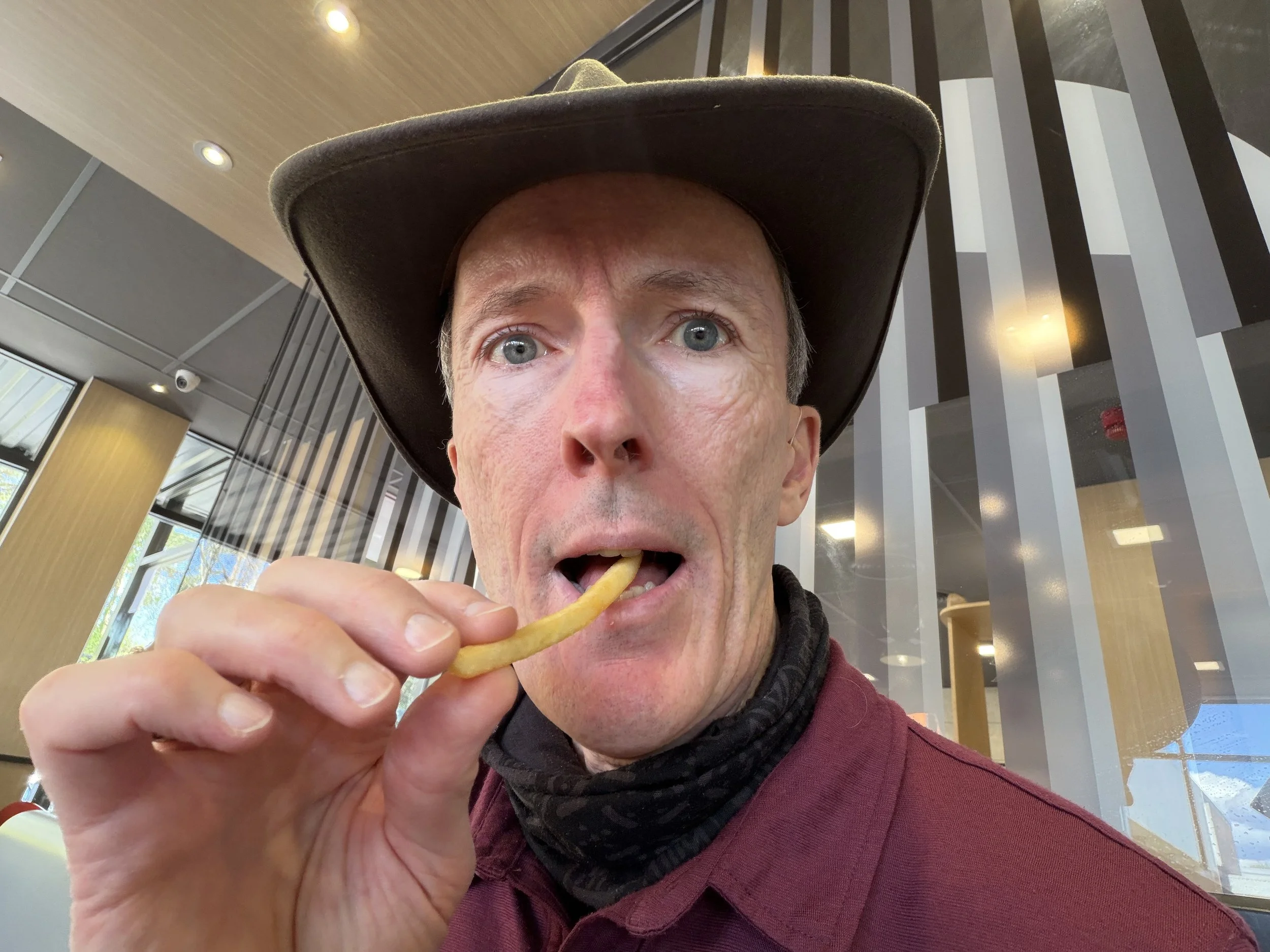
The English French Fry Test
French fries in England have 4 ingredients. In the US, 323 (or something like that). Which tastes better?
Notable Items
While getting to the Tank Museum when it opened took some work, learning of its existence (thanks to LLM itinerary planning) and that this was one of only two “Tiger Days” were lucky. With the static displays, regular museum exhibits, and an afternoon mock battle, it was an all-day affair.
The drive to the museum in Bovington (sounds like a cow sanctuary) was a good sample of English cross-country driving. It was another reason to be cautious about driving in foreign countries. First, I sampled three types of roadways. After getting outside the Portsmouth city limits, I began on a highway (“motorway” to the English). Next, I downsized to a “primary route,” mostly divided (“dual carriageway” to the English) that we tend to call state routes in the U.S.. Finally, a rural single lane road since the museum is in the country. This is called a road, similar to the U.S.
I didn’t eat breakfast in Portsmouth because I left at 6:30am (nothing open). No problem, I thought. I’ll just stop somewhere along the way. This is how I learned that the English approaches to roadside eating and highway signage are much different than the U.S. Signs along the primary route showing restaurants ahead? Nope. There were places to eat, like McDonald’s, but there was no sign to tell me that it was ahead. I only caught a glimpse of the arches in my peripheral vision, in the distance. This happened while I was negotiating a roundabout, listening to the map app, counting the exits to emerge in the correct direction, and trying not to hit anyone. “Dang, that was a McDonald’s!” On a different section of the dual carriageway, with trees separating the directions of traffic, I rounded a corner and only saw a Starbucks as I was passing it. “Dang, that was a Starbucks!”
This was when I realized that you had to be made of sterner stuff to find a place to eat on the road in England. None of the namby-pamby “I’ll look for the next sign” stuff like I was used to. I steeled myself to react quickly to the next image flash of a Starbucks and rapidly decelerate from 60 mph to 5 to park without passing *through* the Starbucks. It worked, but my “reward” was the execrable donut (the latte was good).
The tank museum was huge. My favorite section was devoted to the invention of the tank near the end of WW1. They were originally called “landships” because initial development was by the Navy. Yes, the Navy because Winston Churchill was the motive force when he was First Lord of the Admiralty. Throughout his career, Churchill was the embodiment of the adage, “If you want to have a few brilliant ideas, generate plenty of ideas.” Most of his ideas were lunacy, but a few were spot on. Security was so tight they used the code name “water carriers,” which workers converted to “water tanks” and then tanks.
Following the narrated Tunisian Campaign battle at the Tank Museum, I stopped at the McDonald’s I passed earlier (after circling the roundabout *twice*, “Look kids, Big Ben, Parliament”). I wasn’t particularly hungry after the “spicy” chicken green curry over rice from a parking lot food stall (spicier on the sign than in my bowl).
The stop permitted me to do a french fry taste test. My great niece is fond of pointing out that McDonald’s french fries in the U.S. have more than 10 ingredients, while the English version has just four (and one of those is “potato”). She only does this *while* I’m eating them. I think she is trying to be helpful, but I would rather not think too deeply about food additives while I’m eating. The test result, which should be considered preliminary because I lacked a reference, was “needs salt.”
Back in the room above the garage in Portsmouth, I went into “nuclear engineer mode” to battle with the heater remote control. I experimented with button combinations until I learned how to put it in manual mode. That prevented it from reverting (not “reverting back”) to a lower temperature like it did the previous night. It did generate humming, which the owner surmised was coming from the heater. This would have generated more banging, but I waved him off and texted that it wasn’t bothering me.